
4G Routers
products
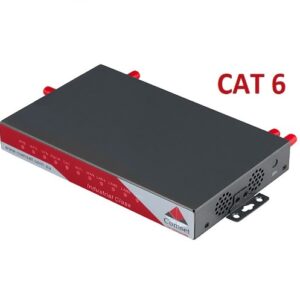
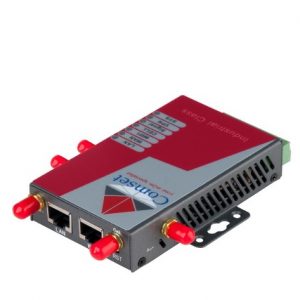
4G Routers for Business, Commercial and Industrial Use in Australia
Comset’s 4G routers connect business, commercial and industrial sites across Australia to a stable mobile network when a fixed-line connection isn’t available, or isn’t reliable enough on its own.
Each unit takes a standard SIM card, supports 4G and 4GX bands, and is engineered for continuous operation rather than home use. Businesses choose a dedicated 4G router because it holds up against temperature swings, vibration and dust that would disable consumer-grade equipment, while giving IT teams remote management and failover options a fixed connection can’t offer.
What Is an Industrial 4G Router and Why It Matters for Your Operations
A 4G router uses a SIM card to convert a mobile network signal into a wired or WiFi connection, giving you internet access anywhere there is cellular coverage. The word industrial matters because these units are built into a metal casing rather than plastic, rated for a wider temperature range, and designed to run unattended for years in a cabinet, vehicle or remote site.
For a business, that means fewer site visits for repairs and a connection that keeps working through a fixed-line outage. Comset designs its range for the machine-to-machine (M2M) sector specifically, so a small form factor and low power draw are standard on every model rather than an upgrade option.
If you want the full technical breakdown, see our guide on what makes a router industrial grade.
How to Choose the Right 4G Router for Your Application
The right model depends on how much data your site moves and how it connects to your network. If you need WiFi for staff or on-site devices, look at the WiFi-enabled CAT-4 or CAT-6 models. If you’re connecting fixed equipment such as cameras or PLCs, a wired Gigabit model may suit better. Sites that can’t tolerate downtime should look at a dual SIM option, which switches carriers automatically if one network drops out.
For a side-by-side view of specifications across our industrial 4G LTE routers, use our router comparison table before you commit to a model, or call our team and describe your site so we can narrow the shortlist for you.
Comset’s Range of 4G Routers: CAT-4 to CAT-6 Models
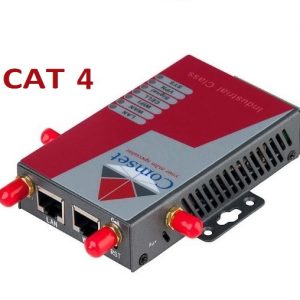
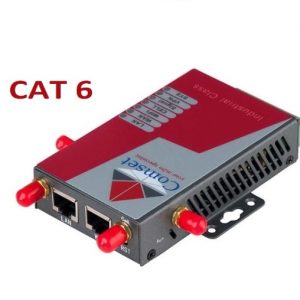
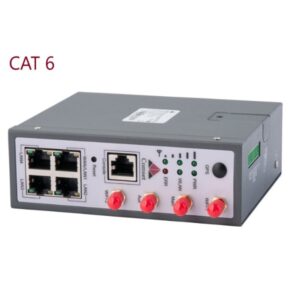
Our current 4G routers span CAT-4 through CAT-6 speed classes, and every model comes with a SIM card slot as standard. The 4G LTE CAT-4 WiFi Router with SIM Card Slot (CM685V-4) suits general-purpose WiFi deployments, while the 4G LTE CAT-6 WiFi Router (CM685V-6) steps up to CAT-6 speeds for higher-bandwidth sites. For locations that need wired Gigabit ports and dual SIM failover, the Dual SIM Dual Band 4-Port Gigabit Router (CM510Q-W) runs four Gigabit ports from two SIM cards.
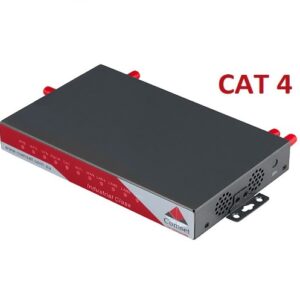
The 4G SIM Router (CM820Q-4) and 4G/4GX LTE CAT 6 WiFi Industrial Router (CM820Q-6) both run on OpenWrt Linux for teams that need VPN and custom firmware control, and the LTE CAT-4 WiFi Router with GPS (CM685V-4-G) adds GPS for asset tracking on mobile deployments. Every model ships in the same solid metal casing, so you can standardise hardware across a fleet or multiple sites without mixing build quality.
Comset 4G Router Delivery and Support Across Australia
Comset is based at Unit 37, 125 Highbury Road, Burwood, Victoria, and ships 4G routers to businesses across every state and territory, from metro Melbourne and Sydney to regional and remote sites in Queensland, Western Australia, South Australia, Tasmania, the Northern Territory and the ACT.
Frequently Asked Questions
What’s the difference between a 4G router and a 4G modem?
A 4G modem converts the mobile signal into a data connection for a single device. A 4G router shares that connection over WiFi or Ethernet to multiple devices at once. Comset’s 4G routers do both jobs in one unit.
Do I need a SIM card for a Comset 4G router?
Yes. Every model in our 4G router range takes a standard SIM card from an Australian carrier such as Telstra or Optus. Dual SIM models take two, for automatic failover between networks.
Can a 4G router replace my NBN or fixed-line connection?
It can, either as a primary connection where fixed-line isn’t available or practical, or as a backup that takes over automatically if your main connection drops. Which setup suits you depends on your data volume and uptime requirements, which our team can talk through with you.
What makes an industrial 4G router different from a home 4G router?
Industrial models are built in a metal casing, rated for a wider temperature range, and designed for continuous unattended operation. Home routers are built for a lounge room, not a cabinet or a vehicle.
Which Comset 4G router suits a WiFi hotspot for staff or visitors?
The CM685V-4 or CM685V-6 are the most straightforward choice for WiFi access, since both are built specifically for SIM-based WiFi deployment. Pick CAT-4 for standard usage or CAT-6 if you expect heavier concurrent traffic.
Do Comset 4G routers work with GPS tracking?
Yes. The CM685V-4-G and CM685V-6-G models add GPS for fleets or mobile assets that need location data alongside their internet connection.